Friday, April 8, 2011

Ecumenical symposium "Bread of life"

The absence of the eucharistic community is still the most painful character of the conflict between Christian churches. In the European Charta Oecumenica require church leaders to the goal of a joint celebration of the Lord of the meal in mind. And on the church ground plane Christians dream of restoring visible unity.


In the more than forty years, Catholics and Protestants working together in conversation about what divides them discovered and articulated a lot of common beliefs in the Eucharist. This discovery is found with joy. This common belief is to a large extent reflected in the renewed liturgical books of the churches. Nevertheless, the eucharistic community is sometimes further away than ever.


In his latest book on the Eucharist, the Catholic oecumenicus Ton van Eijk recorded the progress and obstacles in the ecumenical discussion with the Roman Catholic Church was involved. In a reasoned and entertaining speech Van Eijk summarized the agreements reached at this point. On the basis of a reflection on the Eucharist as bread and word he sees churches having a perspective on the way to remain. That is, if the churches also manage to agree on other thorny issue at this point: the official structures or practice of the Eucharist.The Eucharist has been a considerable stumbling block again towards visible unity since the end of the last century.Especially since in the Roman Catholic Church the admission of women to the priesthood is taboo. What next?


Following the publication of this book is an ecumenical study on March 15 noon (including debate) about the spiritual heart of the ecumenical movement. Assist the author Dr. Ton van Eijk, Dr. Gerrit van de Kamp (Protestant), Dr. Matt Ploeger (Old Catholic) and Prof. Adelbert Denaux (rk). A joint initiative of the Faculty of Catholic Theology (Tilburg University), the Interuniversity Institute for Missiology and Ecumenics (UU), the Catholic Association for Ecumenism and the Council of Churches in the Netherlands, organized by the Theological Institute Luce / CRC. The book is on the symposium at a discount sale for € 12.50.

1700 Relics Discovered in the Cathedral of St. Gertrude Utrecht

St. Gertrude's Cathedral in Utrecht houses a collection of over 1700 relics. Art historian, Anique Kruijf during doctoral work at the University of Amsterdam discovered these relics on March 18 on the subject. 

The Kruijf studied the origin, nature and scope of the collection of the Old Catholic ChurchIn two altars in the cathedral Kruijf discovered the massive collection, consisting of textiles and pieces of bones that had been hidden in cardboard boxes and wooden boxes.
"The size of the collection exceeded all expectations, as relics within the Old Catholic Church has traditionally played smaller role than for example the Roman Catholic Church, " said Dr Kruijf. "Many parishioners did not know there were relics in their church. It was really a little treasure hunting."


"The pomp and pageantry that there used to be around Saints, there is no more, " says art historian. According to Dr. Kruijf, in other cathedrals in the Netherlands there are still many relic treasuries.There are probably not such a large collections like this, but there are still plenty of boxes remains sacred to investigate. "The relics in the Cathedral of St. Gertrude will not be visible to the parishioners or visitors but are stored in the altars. "In the seventies and eighties, the one hundred most important relics were brought to the museum of St. Catherine Convent in Utrecht.
The name of the paper written by Dr. Kruijf is,Miraculously Retained and can be purchased for 29,95

Old Catholic Seminary gets new professor

New Testament scholar and church historian Rev. Dr. Peter-Ben Smit begins his new post on March 1, 2011 as the new professor of ancient structures in the Catholic Church Old Catholic Seminary at the University of Utrecht. Smit also remains active as a New Testament professor at the Free University in Amsterdam.The Old Catholic Synod made ​​the appointment of Smit in November. Smit will hold his first seminar ​​on November 30, 2011. The chairman and professor position has been  vacant since April 2010. The chair has existed  since 1974. The position is for "teaching and research in the Old Catholic Church structure, also containing the history and doctrine of the Old Catholic Church.
Professor Smit will focus on the study of the early Christian approach to the interpretation of tradition including the Bible. Interviewed, Smit was enthusiastic about the new position saying, "It is a privilege in this time as a professor to be appointed. I look forward to working with my colleagues at the Old Catholic Seminary and hope to make inspiring contributions to the practice of theology in the Netherlands."

Wednesday, January 12, 2011

Archbishop: "Humility leads us to peace"

(Utrecht) "Modesty makes possible solidarity and solidarity gives us access to a life where we can taste love, God's love," said the Old Catholic Archbishop Joris Vercammen during the New Year's vespers in the cathedral church of Ste. Gertrudis.

The Archbishop said in his sermon on Matthew 12: 14-21, that society is becoming harder. Jesus' ministry on earth shows that we do not have to scream to get attention, "God seeks apparently not the stage and not the thrill of the high word everyone to silence will bring. God shares the humility and embarrassment of those who broken and threaten to languish. " The victory that this is achieved is not that kind of victory with a ruler imposes his will on a conquered. It is the victory of the solidarity that people reconcile with each other ".

Indispensable for reconciliation between people is modesty. It eventually leads to a higher goal: "Humility and reconciliation are the keys to peace (...) If we wish each other the peace of Christ, then we commit ourselves to that peace."

The Archbishop concludes with the words: "If we meet salvation and blessing wish in the new year, is behind the promise ourselves more modest to draw and reconciliation to search. We tell each other the soft power to give more space . It makes us no less combative around! "

The New Year's Vespers of the old Catholic Archdiocese of Utrecht took place last Sunday. The New Year's Vespers of Dick Schoon Bishop of the Diocese of Haarlem took place the Sunday before.

Monday, December 6, 2010

2nd Week of Advent Church Updates

(Amersfoort) The Old Catholic Bishops of the Netherlands wrote an Advent prayer book for the faithful.The Bishops show reflect on similarities between 1st century Israel and the modern day. With an economic crisis and the coarsening of society, Jesus Christ was born into a society under pressure, but he offered a redemptive response, focusing on God's kingdom. If you would like to purchase the book for 1 euro click here.

(Gronigen) At the Sunday Mass on the first Sunday of Advent,  Victor Peter Scheijde was installed as a pastoral worker at the Old Catholic parish of St. Martin, in Groningen, Friesland, Drenthe and the northeast. Victor Scheijde has completed his academic studies in theology and focuses now on his ecclesiastical studies at the Old Catholic Seminary. The pastoral care of the parish has been entrusted to the pastoral worker since the departure of Pastor Anne Duurkoop Utrecht to the parish in September of this year. Reverend Dr. W.B. van der Velde officiated on behalf of the Bishop.

(Bonn) Henriette Crüwell, pastor of the Old Catholic community of St. Cyprian in Bonn in a radio show on WDR 3 / WDR 5 on "... a journey through the country` s gender - About Justice between local men and church women... The Old Catholics have said that the Zeitgeist is not evil, but this is a place to work out the Holy Spirit and challenge us to understand." To listen to the interview click here


(Pakistan) Pakistan's first and only female Anglican priest Reverend Jane Shaw has warned that persecution of Christians in the country is prompting talented potential future church leaders to settle abroad.
She knew of four young pastors sent overseas for training who decided not to return to Pakistan. She said that while there have been incidents of Christians being attacked and killed, the majority of persecution was more insidious. "It’s largely low-level harassment," she said, "not being short-listed for jobs because you’re a Christian, or, if you do get the job, your colleagues making you so miserable that you have to leave. Also, in some cases Christian businessmen have been told that they’ll only get the most lucrative contracts if they convert to Islam." Other harassment includes Christian children being teased or bullied at school, Christian workers being assigned excessive work­loads, Christians being evicted from accommodation without notice, and influential community members occupying Christians' land with impunity.

Saturday, December 4, 2010

The Priory of Prisches in Avesnois, made its entry into the Old Catholic Church

(France) On Prisches, in the rural town of Avesnois, two priests-- Fr. John Lanoy and Fr.Rene Varenne,  founded an Old Catholic Mission community in 1991. Last week , the Archbishop of Utrecht,  Archbishop Joris Vercammen accepted the French Priory of the Good Shepherd. The church numbers about 300 parishioners on a weekly basis.

Father Varenne says, "I see patients. I accompany the dying. I bless houses. I get the wounded people of life." He likes to quote the words of John: "In my Father's house there are many mansions." As to show the diversity of his church.

Archbishop Vercammen preached, "We try to open a church for all these modern problems. The Church is an accommodation, it is the house of God for humans." Also, the time of recognition has come. "We are open to Catholics," said Archbishop Joris Vercammen. "Dissidents perhaps,  not schismatic."

For a video of the event click: Video of the Priory of the Good Shepherd

Wednesday, December 1, 2010

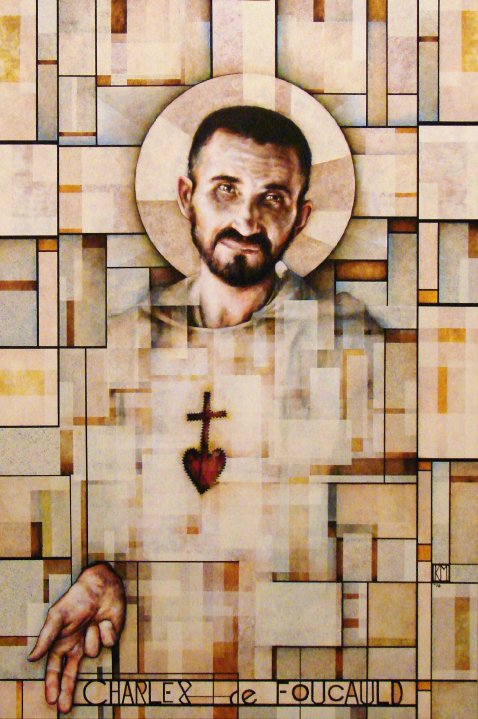
Religious Life in Old Catholicism/ Feast of Bl. Charles de Foucauld

(Providence) The pre-Old Catholic and Old Catholic church has not accepted many forms of Religious Life in the last three centuries although there have been notable exceptions.

One significant event which affected pre-Old Catholicism was when the Cistercian woman's monastery of Port Royal, France. In 1634, Fr. Jean du Vergier de Hauranne, Abbot of the monastery of St. Cyran became spiritual director for the convent of Port Royal. Fr. Jean, a companion and patron of Fr. Cornelius Jansen promoted Jansenist theology at the convent. This school of thought became widely associated with the Little School of Port Royal, their famous monastery school. In 1660, the school was closed for heresy by King Louis XIV, whose spiritual director was a Jesuit, the opponents to Jansen. In 1662, Abbess Antoine Arnauld and Blaise Pascal published the book, Logic, or the art of thinking: The Logic of Port-Royal.  In 1708, Pope Clement XI abolished the convent and had the nuns forcibly removed and many of the buildings destroyed. Beginning in 1992 in Germany, a small group of men and women had been meeting regularly to pray, share the Eucharist, and encourage one another in the spiritual life. In 1999, this small nucleus developed into a religious community called, St. Severin's priory of the Order of Port Royal. In a letter dated 25 October 2010, Bishop Matthias Ring withdrew Old Catholic affiliation with the Order of Ecumenical Cistercian Abbey of St. Severin.


In the Netherlands, during and after the time of the Protestant Reformation, numerous religious who were persecuted as heretics hid in the Netherlands from Jesuit and Papal authorities. Since the Netherlands was a Protestant nation, the Religious were not recognize and could have been persecuted for practicing Catholicism, however, there was no civil authority in the state to enforce the stricter Ecclesiastical mandates from Rome, which made the Netherlands a lesser of two evils. Cistercian and Cathusian communities hid in the Netherlands but eventually died off since they were not allowed to publicly practice their faith. Catholic Priests in the Netherlands would say Mass in hidden churches and would identify themselves by not wearing wigs, colored clothing, and by wearing the simplest Dutch collar. Although the dress of the Priest in public was secular, its distinctive simplicity allowed people to identify them. The Dutch government tolerated this unspoken compromise. There were also communities of Sisters although they also were not allowed to live a traditional religious life. They were unmarried and wore very simple uniform clothing. They would go out into the community to perform corporal works of mercy and would spend much of the day praying.

The Croatian Old Catholics are in the process of building a traditional monastery for religious life. The building project is in its infancy, but hopefully some day, Old Catholic Monasticism may return to Europe. 

In the present day, there are no officially recognized communities of religious although many Old Catholics in the movement have become involved with the Ecumenical Taize community. Taize services are held in parishes all over Europe and the USA. There is also an Old Catholic Little Brother of Jesus Caritas in Germany, Fr. Michael Edenhofer. The Ecumenical Little Brothers and Sisters of Jesus Caritas in the USA are also in the process of admittance into the national ecumenical fraternity, founded by the Roman Catholic Church. Today is the Feast Day of Blessed Charles de Foucauld, the inspiration for the Caritas movement.